DLAB: Design Coursework
REACH Offroad Stretcher Redesign
Project Overview
Project Description
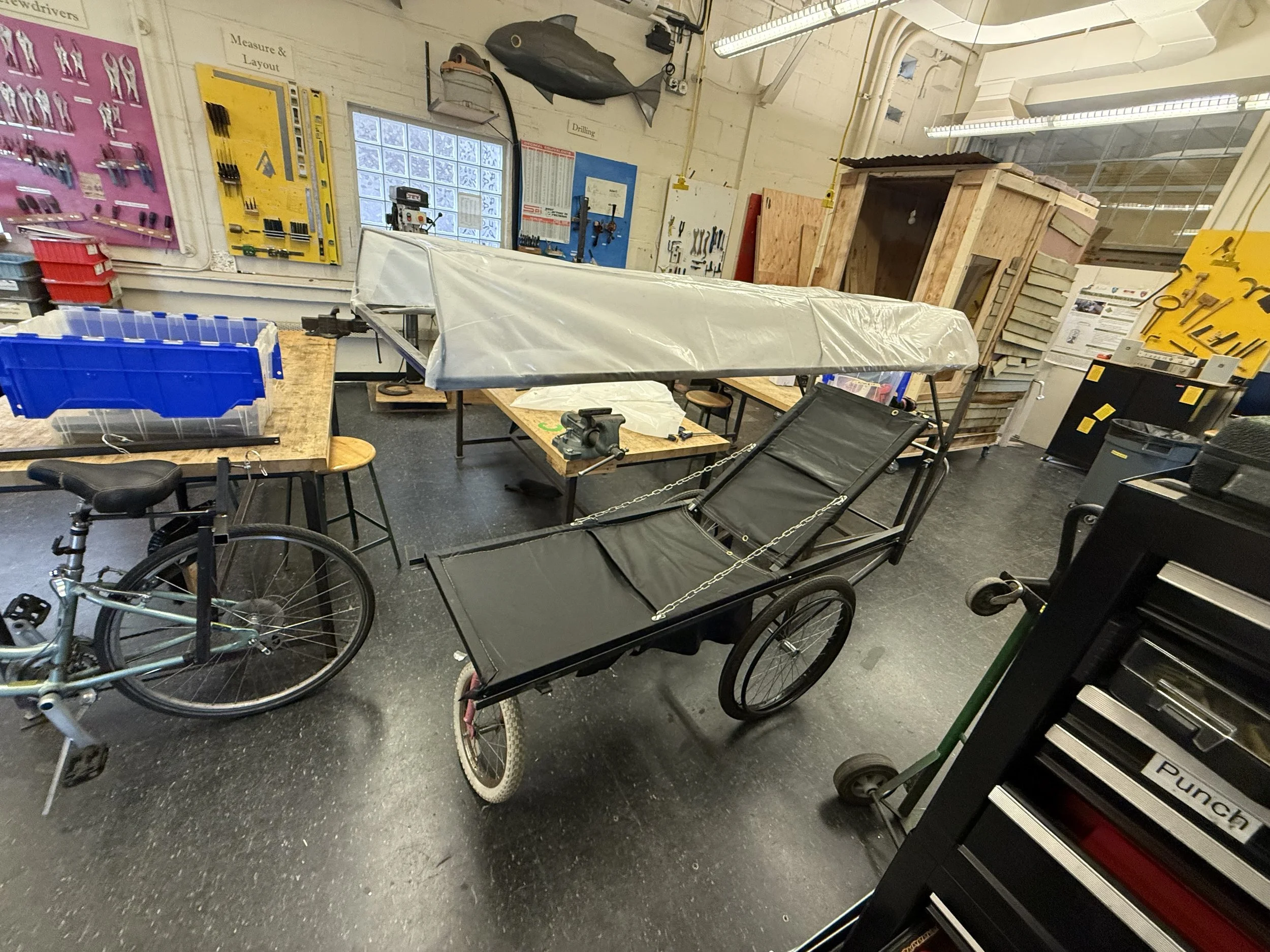
Coursework for MIT EC.720 — D-Lab Design. As part of Team Kickstand (5 members), I worked on the hitch sub team to design, fabricate, and iterate on a bicycle-towable patient transport stretcher for deployment in Langa, South Africa — a township where narrow streets, congested roads, and uneven terrain routinely prevent ambulance access to patients. The project built on prior iterations developed by previous EC.720 students, incorporating field-deployment feedback to address gaps in attachment, shade, and patient comfort.
Team members: Marco, Ruben, Pauline, Kayode, Michelle
Project Details/ My Role
In accordance with the two primary concerns surfaced by user feedback, the team split into a hitch subteam and a shade structure subteam, with all five members converging for cot fabrication and integrated design decisions.
I was a primary contributor on the hitch subteam, responsible for the bicycle attachment mechanism from concept through fabrication and field testing. My specific contributions included:
Designing and iterating on the ball-joint hitch assembly, including selection of the ball joint and pin fastening strategy
Fabricating the decoupled connecting rod — drilling and fitting the tube stock to allow tool-free attachment via clevis pin, eliminating the fixed-protrusion safety hazard of the prior design
Leading the welding of the hitch assembly and associated structural elements, which became my primary fabrication role across the project
Proposing and implementing the chain-based modular seat adjustment system as a simpler, field-repairable alternative to the ratcheting lawn-chair mechanism used in the prior iteration
Design Challenge & Constraints
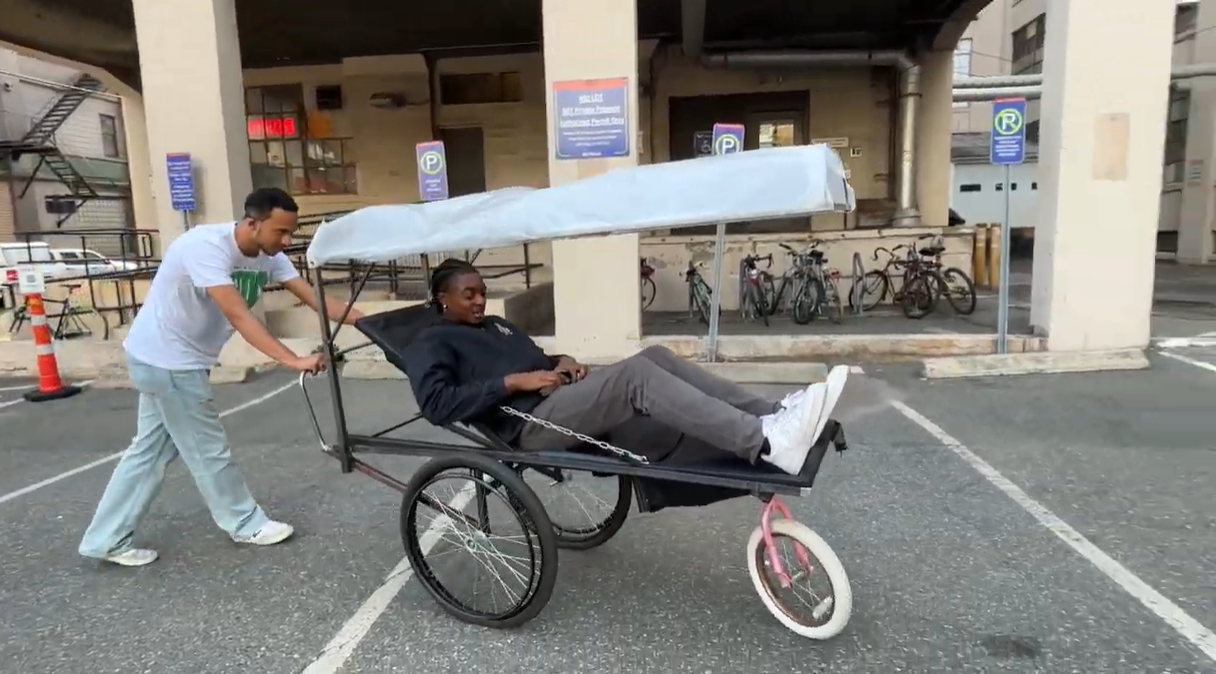
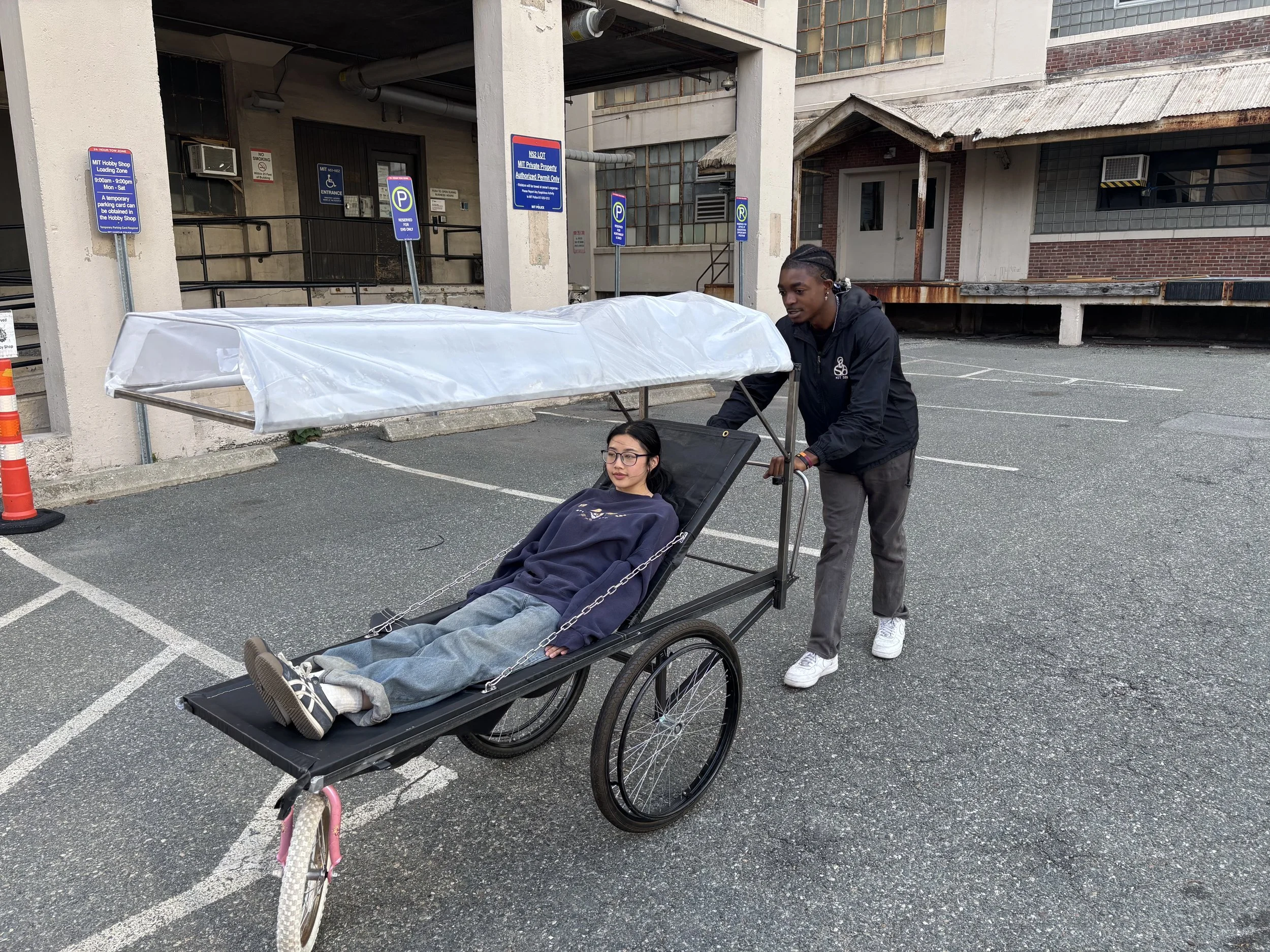
The primary challenge was designing a lightweight, multi-modal stretcher that could be safely towed behind a bicycle over uneven terrain while also being pushed by a single volunteer with a patient on board. The system had to accommodate both use cases without redesign between modes, and needed to be repairable in a resource-constrained environment in Langa, South Africa.
The core mechanical challenge of the hitch in particular was maintaining sufficient degrees of freedom (rotation in yaw for turning and in pitch for hills and bumps) while keeping the overall assembly stiff enough to resist shear failure under towing loads, and compact enough not to protrude dangerously from the front of the stretcher.
Key constraints included:
Terrain: Must navigate narrow township streets, congested roads, and uneven surfaces impassable by ambulance
Safety: Hitch must decouple safely in the event of stretcher tip-over; no patients permitted during bike towing
Repairability: All components must be locally sourceable and maintainable by community bike hubs
Weight: Minimize added mass while maintaining structural integrity under patient loads
Budget: $500 Maximum Spend
Failure Modes & Design Strategy
The dominant risks were:
Hitch bar buckling or shearing under towing forces
Too much weight being put on shade covering leading to bending, shearing, etc.
Stretcher tipping while biking
To address these risks:
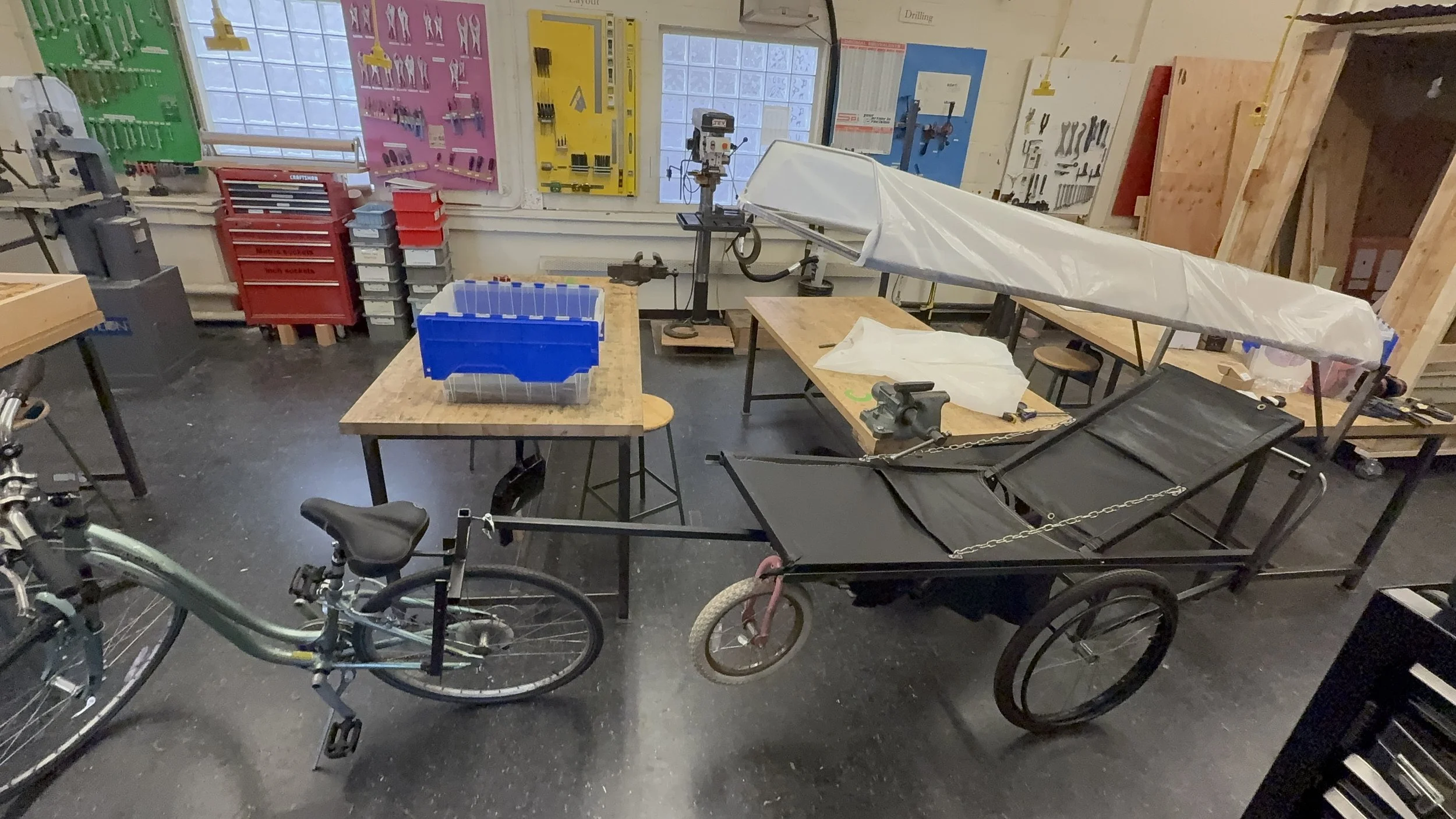
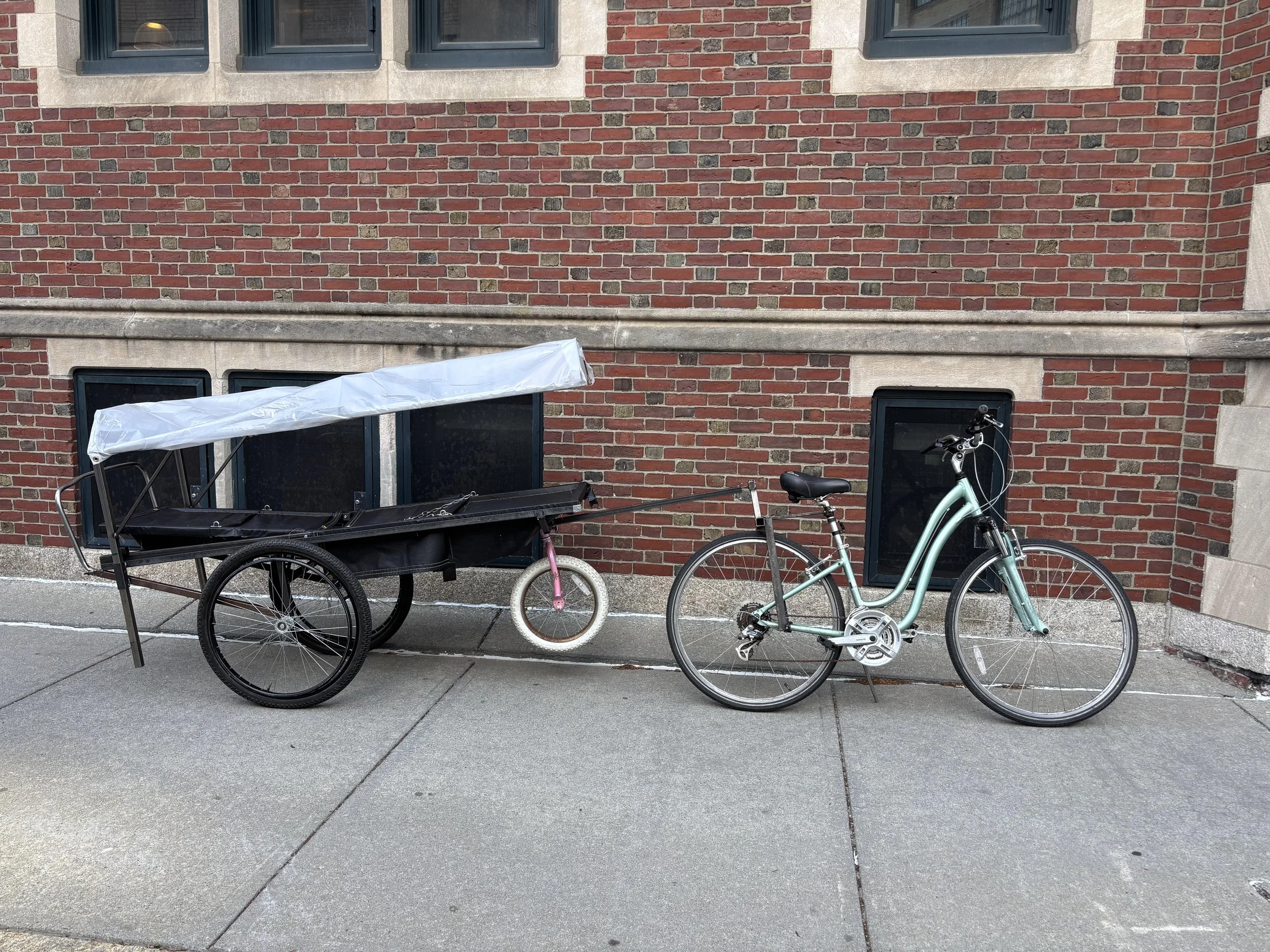
The hitch was redesigned around a ball joint (replacing an earlier flat-bar design prone to buckling) and the connecting rod was made removable via clevis pin, eliminating the hazard of a fixed protruding rod on the front of the stretcher identified during early testing.
The shade structure was reinforced with additional diagonal support bars and stronger welds, and given an adjustable height mechanism to lower its profile during bike towing.
Welded end-stops on the shade structure uprights allow it to drop to a lower pinned position during bike towing, reducing the system's center of gravity and tipping moment during cornering.
The shade structure itself was reinforced with diagonal support bars and stronger welds after DR2 feedback flagged the two-point-only support as insufficient.
Commercial off-the-shelf components (ball joints, shaft collars, clevis pins) were selected over custom-fabricated alternatives specifically because they are replaceable and source-able by community bike hubs in Langa without specialized tooling or processes.
Hitch & Attachment System
We evaluated several linkage and attachment configurations before converging on a ball-joint hitch paired with commercial shaft-collar clamps.
Ball joint provides multi-axis rotational freedom (yaw for turning, pitch for hills) in a minimal profile, replacing the DR2 flat-bar that reviewers flagged as prone to buckling
Threaded ball joint screwed into a welded nut allows the stretcher to self-release on tip-over without pulling down the rider — confirmed through live testing
Off-the-shelf shaft collars clamped to the bike's seat tube attach to any standard bicycle frame and can be permanently fixed or quickly removed for transport
Removable connecting rod attached via clevis pins at both ends enables tool-free attachment and detachment, and is swappable for different lengths as needed
Bending moment calculations were used to validate shade structure support bar sizing against an assumed patient load. For the hitch and overall frame, a functional load requirement of 400–500 lbs was set and used as the testing benchmark; the structure passed under repeated loaded testing with no observed failures.
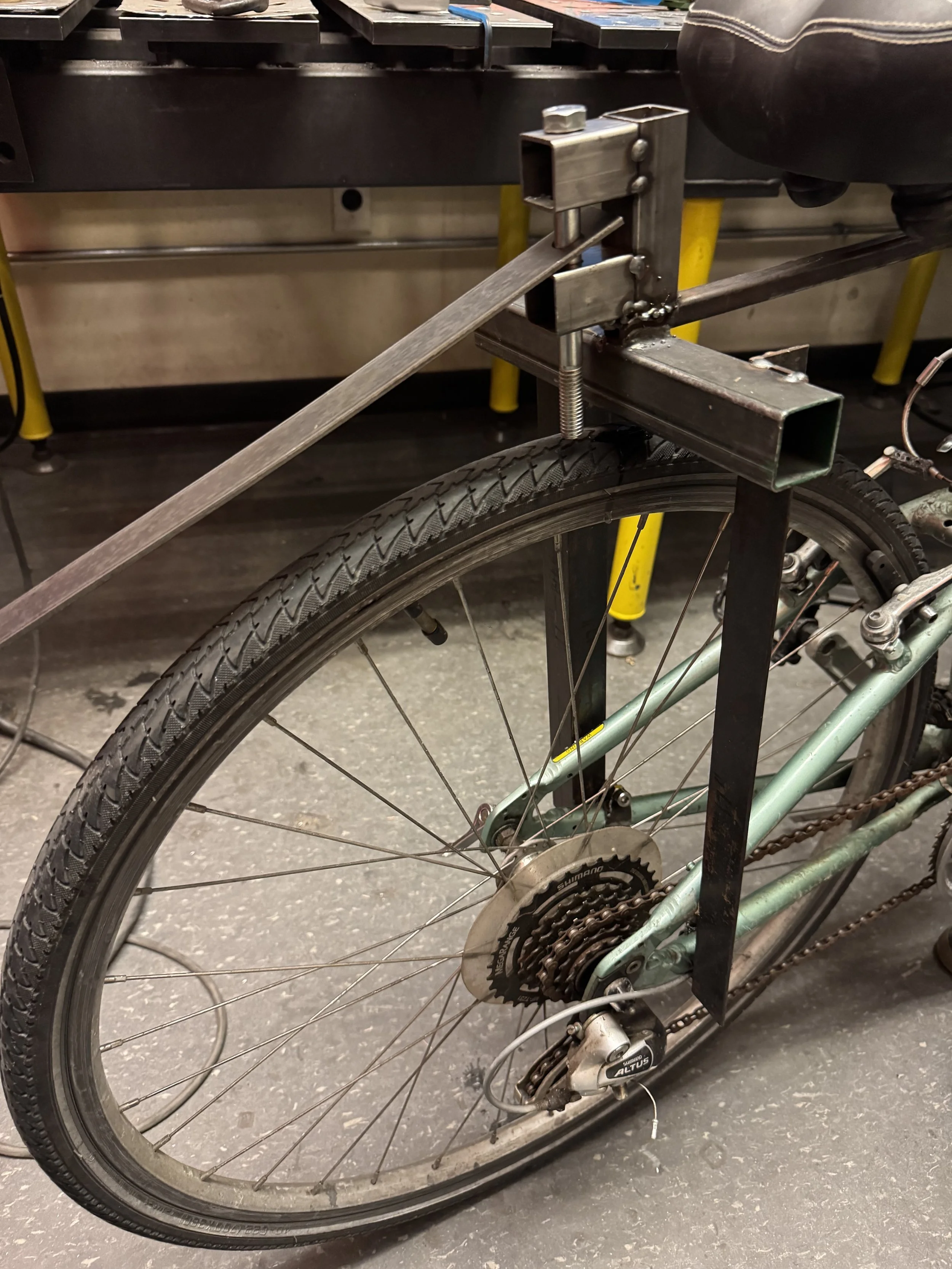
Initial Prototype with Flat Bar Design - Prone to buckling
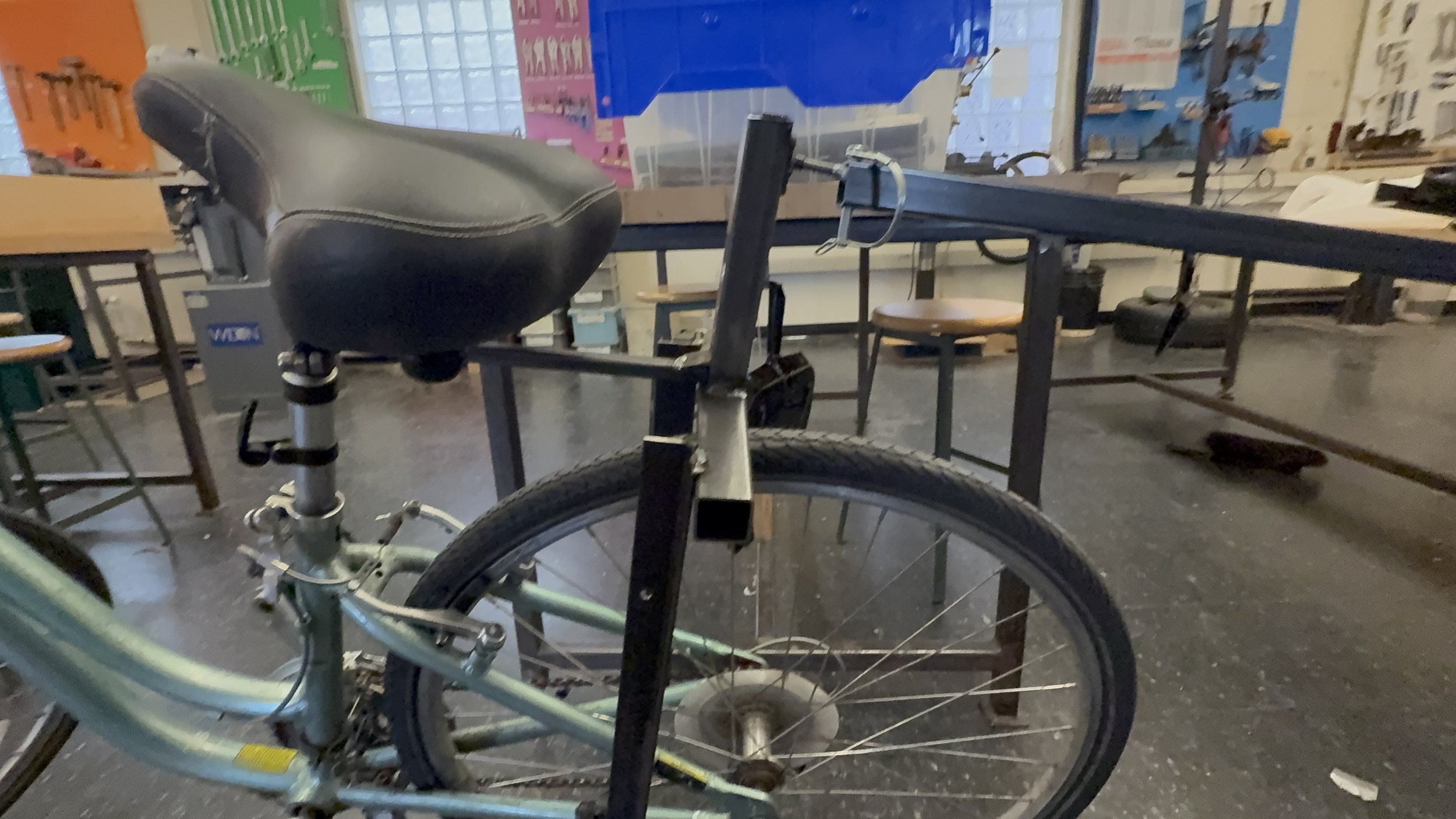
Final Prototype with detachable clevis pin design
Shade Structure & Bed System
Diagonal support bars and increased weld strength added after DR2, addressing two-point-only support failure mode
Adjustable height mechanism pins high during manual pushing (preserving patient and pusher sightlines) and drops low during bike towing to reduce aerodynamic profile and lower center of gravity
Tested under 25 lb point load with no observable deflection vs. unloaded control
Chain-based seat adjustment replaces the prior ratcheting mechanism because it was simpler to fabricate, universally sourceable, and required no special tooling to replace in the field
Video demonstration of photoelectric sensor trigger system for autonomous period
Video demonstration of autonomous-to-manual operation for completion of both Train and Balloon challenges
Fabrication & Integration
The stretcher was fabricated primarily through MIG welding, with additional techniques including cold saw cutting of tube stock, drilling for pin holes, and mechanical fastening via clevis pins and bolts. I developed substantial hands-on welding experience over the course of the project and learned to troubleshoot and clear the lab welder independently when equipment issues caused delays.
Material choices prioritized the repairability constraint throughout: steel tube was used for the hitch arm because it resists buckling more effectively than flat bar under compressive towing loads, and all fastening hardware was selected for local sourceability in a low-resource deployment environment.
Outcomes & Recognition
Successfully delivered a dual-mode stretcher (bicycle-tow and volunteer-push) incorporating all three improvements identified from field deployment feedback:
a functional bicycle attachment system,
a reinforced shade structure with adjustable height,
and a more comfortable, adjustable patient bed.
The hitch was tested on MIT campus streets including curb crossings, tight turns, and a controlled tip-over to validate the ball joint self-release behavior.
Reflection
Fabrication always takes longer than expected — earlier subsystem integration testing would have revealed fit issues with the clamps and rod alignment before they became time-critical.
I also came away with a clearer understanding of how deployment context should drive design decisions: choices that seem like compromises in a lab setting (off-the-shelf hardware, chain adjustment, simplified fastening) are often the right engineering decisions when the end-user needs to fix something themselves with locally available tools.
The most durable designs fail gracefully and are easy to repair, not just hard to break.